Drew McManus has his annual compensation reports available over at adaptistration.com – I’d encourage you to take a look of how much we all get paid is of interest to you. What I found interesting was the relationship of executive and music director compensation to that of the orchestra members.
First, a bit of perspective. Here’s the ratio of average CEO compensation to average worker compensation from 1980 to 2006:

Basically, in 1980, the average CEO was making 42 times what the average worker was making. In 2006, it was 364 times worker compensation. That’s some rate of inflation!
So, here are the numbers that I came up with based upon Drew’s figures from 2007, using the top 7 orchestras:
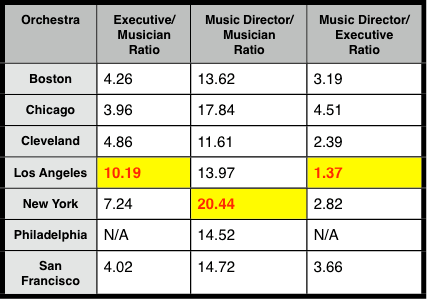
I’ve highlighted the three numbers that initially jumped out at me.
First, the highest ration of executive pay to musician pay is in Los Angeles, Deborah Borda makes just over 10 times the base pay of the LA Phil’s musicians. This may be well-deserved, as LA is riding on top of the world right now, moving from one acclaimed music director (Esa Pekka Salonen) to the hottest wunderkind on the planet, Gustavo Dudamel in 2009, plus they’ve got the best hall in the nation with Disney Hall. Not a bad place to be.
But here’s the interesting number, Salonen makes just over 1.3 times Borda’s salary. It’s the lowest ratio in the top 7, and it may be the only number which truly reflects what a team effort it is to run a major orchestra in this day and age, with a partnership between the business arm and the artistic arm being crucial to an ensemble’s success.
Compare this to Chicago, where Barenboim was making over 4 times the salary of Deborah Card, the orchestra’s president. This from a music director who abruptly left the orchestra over being unhappy about the amount of administrative/fund-raising work he was required to do. Does that somehow earn him 4 times the salary of someone who is doing most of that work already?
The final statistic that is of interest to me is how relatively in-line the salaries of the executive directors/presidents of these orchestras are to the base wages of their musicians. Compared to the for-profit sector, which is now paying an average of 364 times workers’ wages to its CEO’s, orchestras’ boards are keeping executive pay (and music director pay, for that matter) much better in line with their musician’s wages.
One could argue that a music director isn’t so valuable that he/she is worth between 11 and 20 musicians’ salaries, but I’m certain that in some cases that is very much the case in terms of drawing audiences to hear concerts, with all the ticket sales that that entails.
Anyway, some food for thought.
Discover more from NobleViola
Subscribe to get the latest posts sent to your email.
7 replies on “executive and music director pay”
Charles – I think you need to reverse the heading on the last column, so it’s Music/Executive Director ratio.
Thanks for noticing that – I was in a hurry to get out the door when I made the chart!
Very cool chart on these stats from Drew, Charles. I love these kinds of studies!
Notice it?? for a moment I thought, “we’re not in Kansas (or Canada) anymore Toto. Look at this! executive directors in the big orchestras make more than their music directors….”
Interestingly enough, in some cases executives do earn more than the music director on a regular basis (not counting situations were either individual is only employed for part of a season). Nearly 25% of ROPA executives have earned more than their respective full-season music director for three or more of the most recent seasons where data is available.
For ICSOM ensembles the number was lower, just under 10%, and in some cases the situation has existed for only the two most recent years. In each of these cases, the situation exists in middle to lower budget ensembles but in the instances throughout ROPA ensembles, the situation was widespread. As such, as Elaine points out, it is safe to assume that this isn’t the case in the higher budget ensembles but it is an interesting enough trend.
Thanks for putting all that together Charles, I’ll include a link over from the “subscribers only” article going up at the end of the week.
Another interesting perspective to CEO/ED compensation is to take into consideration which ensembles own and/or manage their main performance venue. For example, the CEO at Nashville Symphony had a significant jump in compensation one season but that also corresponded with the opening of their new hall, which they own and operate. As such, it’s fair to say that his duties and responsibilities increased on par with the increase compensation.
Best,
Drew McManus
WARNING, GRATUITOUS PLUG: To find out which ensembles have consistently paid executives more then music directors, pick up a copy of the print edition of the 2008 Orchestra Compensation Report, on sale now.
So, here’s an idea (hint, hint) for a future article, Drew: why are music directors of the larger orchestras suddenly worth so much more than for the smaller ones? I’d argue that the inverse is true, that the larger the orchestra, the more vital the role of executive director/president becomes, and that’s where LA has gotten it right (for the past few directors, I’d argue, not just Borda). Sure, the MD is important for the artistic vitality of the organization, but if you have a visionary board leader and a capable president/E.D. then you’ll do well regardless of how much of a “name” your MD is – thoughts?
Good ideas Charles (hint, hint, taken, taken). To a small degree, some of the past compensation reports have discussion threads which examine those very issues although a reader has to slog through the comments to get everything.
One of the reasons the online reports focused on quantifiable content this year is becasue so many of these issues don’t have universal solutions that defy “answers” in the traditional sense. At the same time, I think the conversations defining the issues related to executive leadership at the administrative and artistic levels is extremely valuable so communities/individuals can begin to formulate their thoughts on the matter and how it applies to their respective orchestra.
The trick is to keep from getting tangled up in the semantics 🙂